

The Great Inversion:
For fifty years, the “safe” path was obvious: go to college, get a degree and find a job in a climate-controlled office. That path is no longer safe.
We are witnessing the greatest inversion of labor value in history. The digital world—where we spent decades trying to migrate—is becoming infinitely abundant and cheap. If your job is mostly done on the computer, it’s melting ice.
The new scarcity is Reality.
As AI drives the cost of intelligence toward zero, the value of the things AI cannot do will skyrocket. We will see two safe harbors:
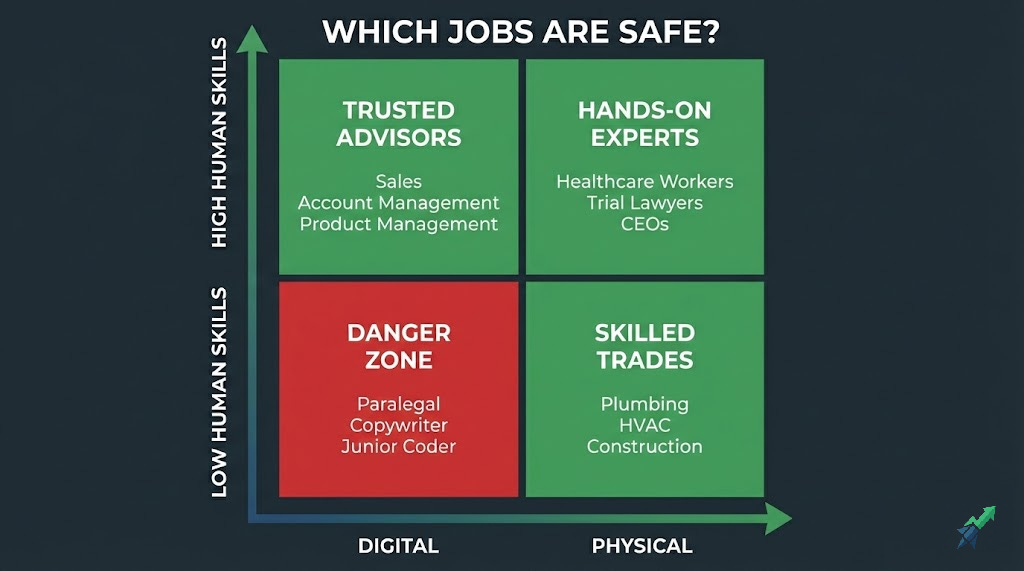
The first harbor is The Physical. Robots are coming, but they are much further behind. They cannot snake a drain, troubleshoot a messy HVAC system in a 100-year-old house, or handle the chaotic, unstructured environment of an emergency room. Dexterity is the new currency. If you can manipulate the physical world with your hands, your value is about to go up because you cannot be copy-pasted.
The second harbor is The Human. We are biological creatures who crave connection. An AI can diagnose a disease, but it cannot hold a patient’s hand and navigate them through fear. An AI can write a contract, but it cannot look a client in the eye to build the trust necessary to sign it. The “soft skills”—negotiation, empathy, sales, leadership—are becoming the “hard skills.”
The danger zone is everything else. If your output is digital and impersonal, you will be competing with an army of infinite agents that don’t sleep. To survive, you must move to where the computer cannot follow: into the mud of the real world, or into the complexities of human connection.
The Stage Two Job Playbook:
1. Move toward a safer quadrant: Look at your current trajectory. If you are in the danger zone (digital job with low human skills), you need to pivot either laterally within your organization or to a new job altogether. Do not wait for the layoff; beat the rush to the exit.
2. Automate the automatable: Break your role down into individual tasks. Identify what can be automated and aggressively automate them using AI tools, scripts, and agents. Do not ask for permission. If you can automate 60% of your grunt work, you free up massive bandwidth to focus on the high-value, creative, human tasks or to focus more energy on point #4.
3. Adopt AI as a force multiplier. The divide won’t be “AI vs. Humans.” It will be “Humans with AI vs. Humans without.” You need to remain on the cutting edge of AI. This will make you the most valuable person on your team or allow you to thrive at building your own business.
4. Build a Second Income Stream: Your salary is a single point of failure in a volatile system. You need a second stream of revenue that is uncorrelated to your employer. The goal isn’t just “extra cash”—it’s leverage. When you don’t need the job to survive, you negotiate from a position of power. This also could be your opportunity to make your dream job a reality, which we’ll write about more in the future.